Free UK tracked delivery on research orders over £75 — dispatched same day before 3pm
Free UK tracked delivery on research orders over £75 — dispatched same day before 3pm
Choosing the right peptide supplier in the UK requires more than comparing prices. Learn the key factors to check, including COAs, batch traceability, testing, transparency and UK-based service.
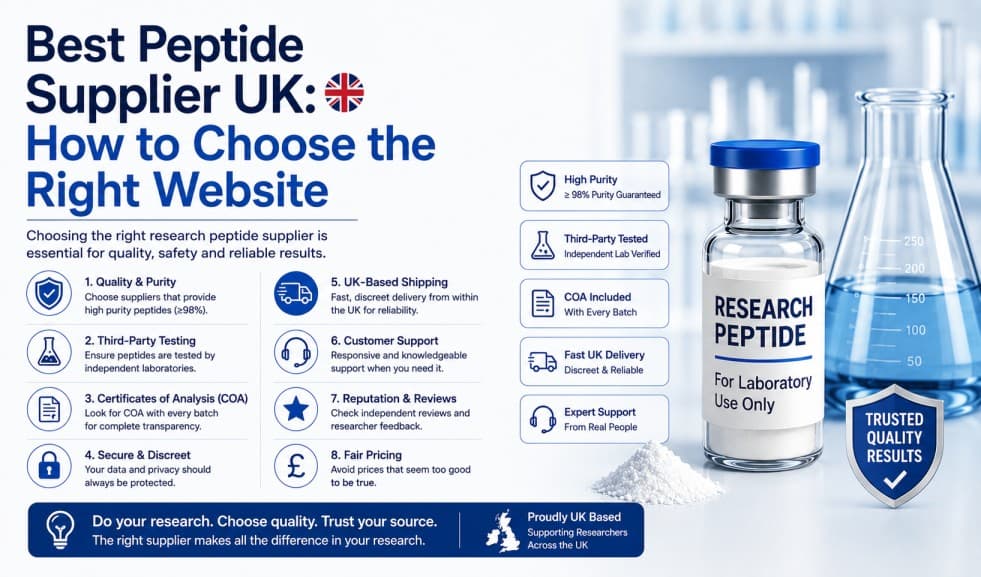
The UK market for peptides has grown quickly over the past few years, and with that growth has come a flood of websites all claiming to be the "best" or "most trusted" supplier. For anyone trying to sort genuine, quality-focused vendors from the rest, the process can feel overwhelming. This guide breaks down the practical criteria that actually separate a reliable peptide website from a risky one.
In the UK, peptides sold online are almost always marketed **for research purposes only** and are explicitly labelled as not for human consumption. Legitimate suppliers are upfront about this distinction — it affects how they can legally advertise, package, and sell their products. Any site that blurs this line, makes medical claims, or offers dosing advice for personal use should be treated as a red flag rather than a selling point. This guide focuses on evaluating suppliers within that legal research framework.
This is the single most important factor. A trustworthy supplier will:
Provide a Certificate of Analysis for each batch, not just each product line
Use an independent, accredited third-party lab — not an in-house test
Make CoAs easy to find, usually via a batch number or QR code on the product page
Test for purity, identity, and often contaminants like heavy metals or bacterial endotoxins
If a site only shows a generic "purity guaranteed" badge with no downloadable report, that's a gap worth noting.
Look for basic business transparency:
A registered UK company number (checkable on Companies House)
A physical business address, not just a PO box
Clear contact information, including a working phone number or live chat
An "About Us" page that explains who runs the company and their background in the field
Anonymous or vague "about" sections are a common trait of lower-quality operations.
Established suppliers tend to have a well-organised catalogue with:
Clear, consistent naming and dosage-per-vial labelling
Detailed product pages including molecular formula, CAS number, and storage requirements
Reasonable range depth (not an implausibly huge catalogue that suggests reselling from unknown sources)
Be cautious of sites that list dozens of obscure compounds with thin, copy-pasted descriptions.
Peptides are sensitive to temperature and light. A quality supplier will:
Ship with appropriate cold-chain packaging (ice packs, insulated boxes) where required
Clearly state shipping times and tracking availability
Package products securely and discreetly, with tamper-evident seals
Offer UK-based dispatch, which usually means faster delivery and clearer customs handling
Don't rely solely on testimonials posted on the supplier's own site. Instead:
Check independent forums and communities where researchers discuss suppliers
Look for a consistent pattern of feedback over time, not just a handful of five-star reviews
Search the company name plus terms like "review" or "complaint" to see what comes up
Be wary of suspiciously uniform, overly enthusiastic reviews with no specifics
A legitimate business will have clear, accessible policies covering:
Returns and replacements for damaged or incorrect shipments
Order tracking and communication if there are delays
A responsive support channel — try emailing a pre-purchase question and see how they handle it
Slow, evasive, or scripted responses are worth noting before you commit to an order.
Check that the checkout process:
Uses secure, encrypted payment processing (look for HTTPS and recognised payment gateways)
Doesn't pressure you into unusual payment methods like direct bank transfers or cryptocurrency only, which can be harder to dispute
Provides clear invoicing for record-keeping
Read the fine print. Reputable UK suppliers will have:
A clearly stated "for research use only, not for human or veterinary use" disclaimer
Terms and conditions that reflect UK regulations around research chemicals
No promotional language implying the products are safe or effective for personal health use
Rather than chasing a single "best" website, it's more useful to run any candidate supplier through this checklist:
| Criteria | What to Look For |
|---|---|
| Lab testing | Batch-specific, third-party CoAs |
| Transparency | Registered company, real address |
| Product info | Detailed, accurate specifications |
| Shipping | Proper packaging, UK dispatch |
| Reputation | Independent reviews, forum feedback |
| Service | Responsive, clear policies |
| Payment | Secure checkout options |
| Compliance | Honest, research-only labelling |
A site that checks most or all of these boxes is far more likely to be operating responsibly than one that relies on flashy marketing alone. Take your time comparing a few options against this list before making a decision — the extra ten minutes of due diligence is worth it.
This article is provided for general informational purposes and does not constitute medical, legal, or purchasing advice. Products discussed are typically sold for research purposes only and are not intended for human consumption.
This article is provided for educational purposes to support laboratory research. All products supplied by UK Peptides are for in-vitro research use only and are not medicines, supplements, or intended for human or veterinary consumption.