Free UK tracked delivery on research orders over £75 — dispatched same day before 3pm
Free UK tracked delivery on research orders over £75 — dispatched same day before 3pm
Discover the science behind GHK-Cu 100mg in this complete research overview. Learn about its molecular characteristics, copper-binding properties, analytical considerations, and potential applications in laboratory research. This guide is intended for researchers seeking clear, research-focused information about GHK-Cu.
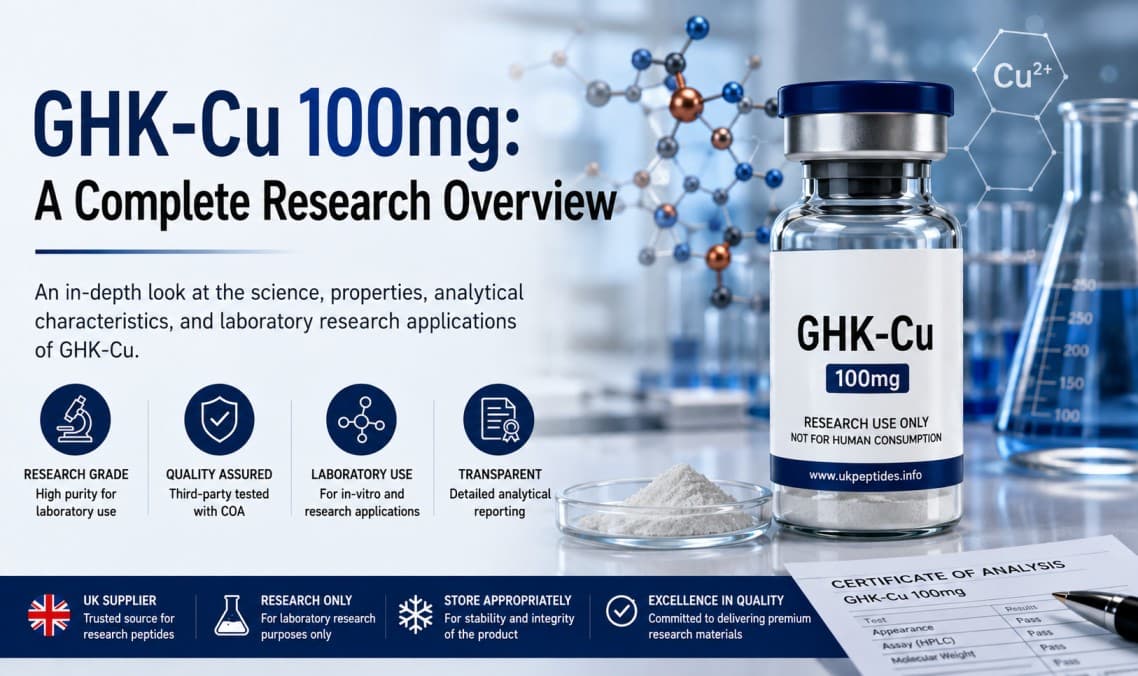
GHK-Cu — glycyl-L-histidyl-L-lysine bound to a copper(II) ion — is one of the most extensively studied copper-binding tripeptides in laboratory science. Sold in research-grade formats such as 100mg vials, it has become a staple reagent in laboratories investigating tissue remodelling, dermal biology, and copper-dependent enzyme systems. This article summarises what the current body of published research says about GHK-Cu, why the 100mg format is common in laboratory settings, and what researchers should know before incorporating it into a study protocol.
GHK-Cu was first isolated from human plasma in the early 1970s by researcher Loren Pickart, who observed that older liver tissue samples behaved in a more youthful manner in cell culture when the peptide was present. Structural confirmation followed later that decade, and by the late 1980s the compound had drawn broad interest across dermatological and wound-healing research. Today it is one of the most published tripeptides in the peptide research literature, with study areas spanning skin biology, extracellular matrix remodelling, antioxidant defence, and gene expression.
Research suppliers typically offer GHK-Cu as a lyophilised (freeze-dried) powder in set quantities — 50mg, 100mg, and 200mg are common — rather than as a pre-dosed or ready-to-use solution. The 100mg vial size is popular in laboratory settings because it provides enough material for multiple reconstitutions across a series of *in vitro* experiments (such as fibroblast culture assays) while remaining practical to store and handle. Reconstitution, storage conditions, and handling protocols are matters for the receiving laboratory's own standard operating procedures and should be determined by qualified personnel — this article does not provide instructions for personal or human use.
Free copper ions are cytotoxic at elevated concentrations, so the body relies on chaperone-like carriers to shuttle copper safely to where it is needed. GHK-Cu binds copper with a very high affinity, and researchers have proposed that this chelation allows the peptide to deliver bioavailable copper to enzymes that depend on it — including lysyl oxidase, which is involved in collagen crosslinking, and superoxide dismutase, an antioxidant enzyme. This copper-chaperone hypothesis is one of the central mechanistic threads running through GHK-Cu research.
In fibroblast cell culture models, GHK-Cu has been observed to influence the synthesis of structural proteins including collagen, elastin, and glycosaminoglycans, as well as enzymes involved in matrix turnover such as matrix metalloproteinases and their tissue inhibitors. Researchers have described this as evidence that the peptide may coordinate a broader remodelling programme rather than simply stimulating collagen output in isolation. Some studies have also noted that the relationship between concentration and matrix organisation is not strictly linear, which is an area still under active investigation.
A separate strand of research has examined GHK-Cu in models of oxidative stress and inflammation, particularly in macrophage cell cultures. In these settings, GHK-Cu has been associated with reduced reactive oxygen species production and restored superoxide dismutase activity, effects that researchers attribute partly to its role in copper enzyme cofactor delivery.
More recent investigations have used GHK-Cu as a tool compound in transcriptomic studies, examining how it influences gene expression patterns in cultured cells. Some published work has reported that GHK-Cu treatment shifts the expression profile of aged fibroblasts toward patterns more typical of younger cells, touching on pathways such as TGF-beta and Wnt signalling. This line of research remains preclinical and exploratory.
GHK-Cu is frequently studied in combination with other research peptides, including BPC-157 and TB-500, in multi-compound research protocols aimed at understanding tissue repair signalling more broadly. Comparative work has also examined GHK-Cu against structurally related copper peptides such as AHK-Cu, to isolate which effects are attributable to the peptide backbone versus the copper ion itself. These comparative and combinatorial study designs are covered in more depth in our other research articles on GHK-Cu vs AHK-Cu, GHK-Cu vs BPC-157, and GHK-Cu vs TB-500.
Because GHK-Cu's biological activity depends on the intact copper-peptide complex, purity and a genuine Certificate of Analysis (CoA) matter for reproducible results. Researchers evaluating a 100mg vial should look for third-party HPLC and mass spectrometry data confirming peptide identity and purity, along with clear batch documentation. Variability in copper coordination or peptide degradation between batches can materially affect experimental outcomes, which is why sourcing from a supplier with consistent quality control is an important part of good laboratory practice.
It is worth being clear about where GHK-Cu research currently stands: the large majority of published data comes from in vitro cell culture work and animal models, with more limited human clinical data — most of which relates to topical cosmetic applications rather than systemic use. Claims about GHK-Cu's effects should therefore be understood as preclinical findings that warrant further investigation, not established outcomes in people.
GHK-Cu remains one of the most studied copper-binding peptides in laboratory science, with a research base spanning copper biology, extracellular matrix remodelling, oxidative stress, and gene expression. The 100mg format is a practical laboratory quantity suited to multiple experimental runs. As with any research compound, outcomes depend heavily on peptide purity, correct storage, and appropriate experimental design.
Research Use Disclaimer: This article is provided for informational and educational purposes only. GHK-Cu and all products listed on ukpeptides.info are sold strictly for laboratory research use by qualified professionals and institutions. They are not licensed medicines, are not intended for human or animal consumption, and have not been evaluated by the MHRA for safety, dosing, or efficacy in people. Nothing in this article constitutes medical advice or a recommendation for human use.
This article is provided for educational purposes to support laboratory research. All products supplied by UK Peptides are for in-vitro research use only and are not medicines, supplements, or intended for human or veterinary consumption.