Free UK tracked delivery on research orders over £75 — dispatched same day before 3pm
Free UK tracked delivery on research orders over £75 — dispatched same day before 3pm
GHK-Cu is a copper-binding tripeptide studied in various areas of skin biology research. This scientific overview examines its molecular properties, copper interactions, extracellular matrix research, collagen studies, and other laboratory research areas.
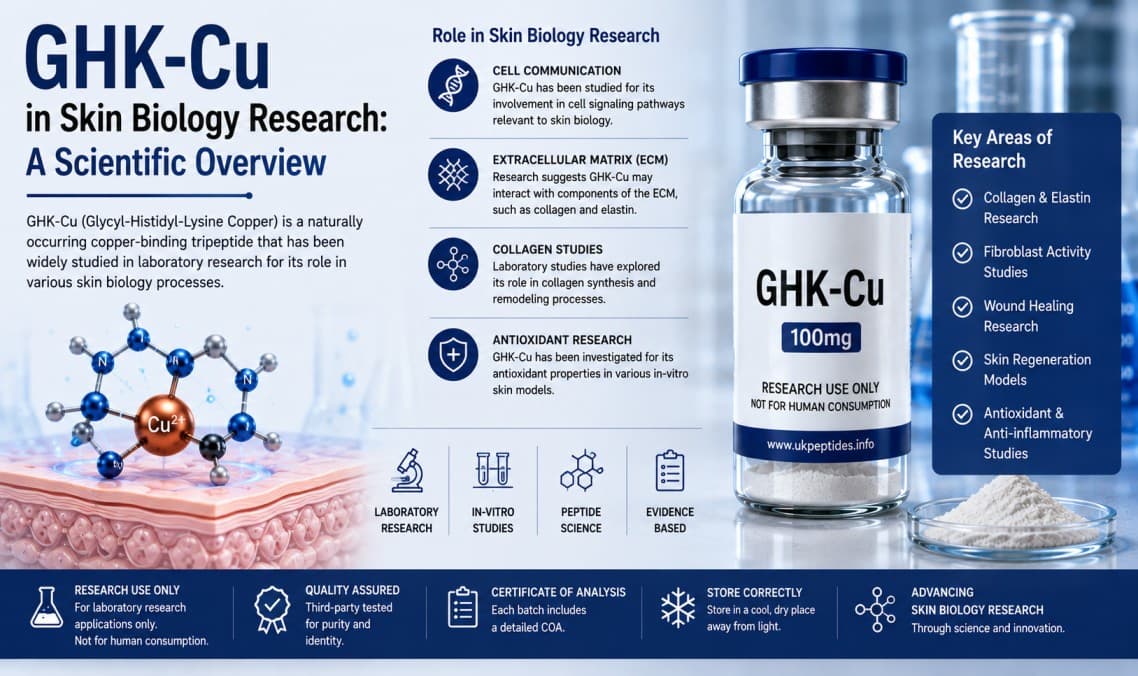
Few areas of GHK-Cu research are as extensively published as its role in dermal biology. From fibroblast culture studies to gene expression profiling, GHK-Cu has become something of a reference compound for laboratories investigating extracellular matrix remodelling, collagen synthesis, and skin ageing at the cellular level. This article surveys what the research literature currently says about GHK-Cu's activity in skin-related models.
The dermis owes much of its structural integrity to the extracellular matrix (ECM) — a network of collagen, elastin, glycosaminoglycans, and other structural proteins produced primarily by fibroblast cells. A substantial portion of GHK-Cu research has focused on how the peptide influences fibroblast behaviour in culture.
In fibroblast cell culture models, GHK-Cu exposure has been associated with increased synthesis of type I collagen, along with elastin, fibronectin, and proteoglycans — the structural proteins that give skin tissue its firmness and elasticity. Some studies report this occurs partly through increased transcription of collagen genes such as COL1A1 and COL1A2, alongside improved post-translational processing of procollagen into its mature, matrix-incorporated form. Radioactive proline incorporation assays — a standard technique for measuring new collagen synthesis — have been used in several studies to confirm increased collagen production rates in GHK-Cu-treated fibroblast cultures.
An interesting theme running through the literature is that GHK-Cu does not appear to simply push fibroblasts to make more collagen. Researchers have also observed upregulation of matrix metalloproteinases (MMPs), the enzymes responsible for breaking down and remodelling existing matrix components, alongside their natural inhibitors, tissue inhibitors of metalloproteinases (TIMPs). This has led some researchers to describe GHK-Cu's effect as a coordinated remodelling signal — one that promotes both the breakdown of damaged matrix components and the synthesis of new ones — rather than simple stimulation of matrix accumulation. This is a more complex picture than early "collagen booster" framing suggested, and it remains an area of active mechanistic study, including questions about how concentration affects the balance between these processes.
Skin ageing and damage are closely linked to oxidative stress and chronic low-grade inflammation. GHK-Cu research has examined the peptide's activity in this context as well, with studies in relevant cell models reporting reduced markers of oxidative stress and modulation of inflammatory signalling pathways. Researchers have proposed that this activity may be connected to GHK-Cu's role in supporting copper-dependent antioxidant enzymes such as superoxide dismutase, discussed in more detail in our article on the science of GHK-Cu's copper-binding chemistry.
A more recent and rapidly growing area of GHK-Cu research uses transcriptomic (gene expression) analysis to study the peptide's broader effects on cell behaviour. Some published work — including research appearing in genomics-focused journals — has reported that treating aged fibroblasts with GHK-Cu shifts their gene expression profile toward patterns more characteristic of younger cells. Pathway analysis in this line of research has implicated signalling systems including TGF-beta, Wnt, and p53, all of which are involved in processes such as cell proliferation, tissue regeneration, and stress response.
Separately, some research has explored epigenetic mechanisms — including DNA methylation changes — as a possible route through which GHK-Cu influences gene expression over time. This remains an early and exploratory area of the literature.
It's worth distinguishing between two related but different contexts in which GHK-Cu appears. As copper tripeptide-1, it has a long history as an ingredient in topical cosmetic formulations, where its use is governed by cosmetic regulations rather than medicines regulations, and where human clinical data on skin appearance outcomes does exist, largely from industry-sponsored studies. As a research-grade compound sold for laboratory use, GHK-Cu is studied in a broader range of experimental models — including gene expression, wound-healing, and animal studies — and is not intended for direct human application outside of a regulated, finished cosmetic or medicinal product.
Despite decades of research, several questions remain active areas of investigation:
The precise concentration-response relationship for matrix remodelling effects, including reports that higher concentrations can paradoxically reduce collagen organisation in some models.
How GHK-Cu's in vitro fibroblast effects translate into whole-tissue or whole-organism outcomes.
The relative contribution of the copper ion versus the peptide backbone to specific downstream effects — a question also explored through comparative studies with related peptides like AHK-Cu.
GHK-Cu has become one of the most studied compounds in skin biology research, with published findings spanning collagen and elastin synthesis, extracellular matrix remodelling, antioxidant signalling, and gene expression in fibroblast models. While the *in vitro* evidence base is substantial, much of it remains preclinical, and researchers continue to investigate the underlying mechanisms and how they scale to more complex biological systems.
Research Use Disclaimer: This article is provided for informational and educational purposes only. GHK-Cu and all products listed on ukpeptides.info are sold strictly for laboratory research use by qualified professionals and institutions. They are not licensed medicines, are not intended for human or animal consumption, and have not been evaluated by the MHRA for safety, dosing, or efficacy in people. Nothing in this article constitutes medical advice.
This article is provided for educational purposes to support laboratory research. All products supplied by UK Peptides are for in-vitro research use only and are not medicines, supplements, or intended for human or veterinary consumption.