Free UK tracked delivery on research orders over £75 — dispatched same day before 3pm
Free UK tracked delivery on research orders over £75 — dispatched same day before 3pm
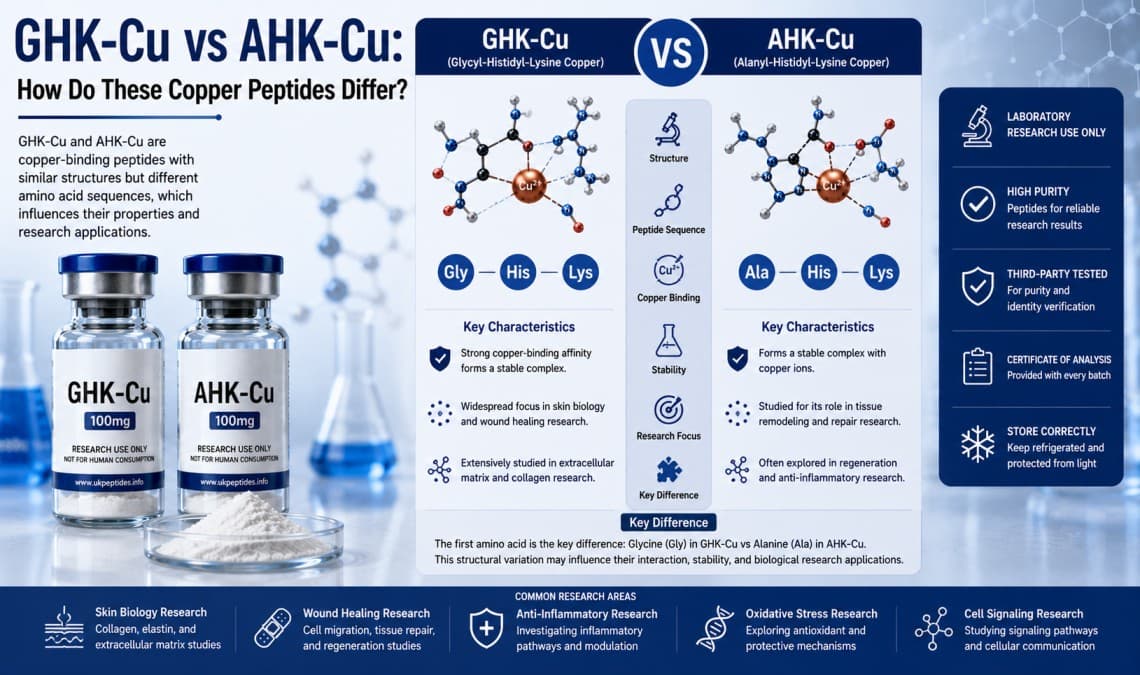
GHK-Cu and AHK-Cu are copper-binding peptides with related structures but different amino acid sequences. This guide examines their key molecular differences, copper-binding characteristics, research properties, and areas of scientific investigation.
Anyone researching copper peptides for more than a few minutes will eventually run into two closely related names: GHK-Cu and AHK-Cu. They look similar, they're both copper-binding tripeptides, and they're often mentioned in the same breath. But they are structurally distinct compounds with different research profiles. This article breaks down what separates them, and where each fits within the current research literature.
Both peptides are copper(II)-bound tripeptides built from three amino acids. GHK-Cu is composed of glycine, histidine, and lysine — hence "GHK." AHK-Cu swaps out the glycine for alanine, giving "AHK": alanine, histidine, and lysine. Both retain the histidine-lysine backbone responsible for coordinating the copper ion, which is why the two compounds share a broadly similar copper-binding chemistry.
In cosmetic ingredient naming, GHK-Cu is known as copper tripeptide-1, while AHK-Cu is designated copper tripeptide-3. This single amino-acid substitution — glycine to alanine — is a small structural change, but researchers have found it shifts where each peptide's biological activity is most strongly expressed.
A key distinction between the two is their origin. GHK-Cu is naturally occurring — it was first isolated directly from human plasma, and it is also detectable in human saliva and urine, with levels known to decline with age. AHK-Cu, by contrast, is a synthetic peptide, engineered specifically as a structural analogue of GHK-Cu rather than isolated from a natural source. This doesn't necessarily make one "better" than the other for research purposes, but it does mean they come from different starting points in the literature: GHK-Cu research often begins from the question "what does the body's naturally occurring copper peptide do," while AHK-Cu research tends to start from "how does modifying the peptide backbone change copper-peptide biology."
The two peptides are studied across overlapping but distinct areas:
GHK-Cu research has the broader footprint, spanning extracellular matrix remodelling, general skin and connective tissue biology, wound-healing models, antioxidant and anti-inflammatory signalling, and gene expression studies related to tissue regeneration and cellular ageing. It is generally regarded in the literature as the more extensively studied of the two compounds, with a research history extending back to the 1970s.
AHK-Cu research is more narrowly concentrated on hair follicle and dermal papilla biology. Several studies have examined its effects on vascular endothelial growth factor (VEGF) signalling in follicular models, an area connected to blood supply and nutrient delivery around hair follicles. This has made AHK-Cu a peptide of particular interest in hair and scalp-focused research, distinct from GHK-Cu's broader tissue-remodelling research profile.
Some researchers frame the distinction this way: GHK-Cu is chosen when a research question involves broad tissue remodelling, while AHK-Cu is chosen when the question is more narrowly focused on localised follicular or dermal-papilla signalling.
Because GHK-Cu and AHK-Cu differ by just one amino acid while sharing the same copper-binding motif, researchers have used the pair as a natural comparative model — a way of asking how much of a given biological effect depends on the specific peptide sequence, versus how much simply depends on copper delivery in general. Studies designed this way can help clarify whether an observed effect is peptide-specific or a more generic consequence of copper chaperoning, which is directly relevant to the broader mechanistic questions covered in our article on GHK-Cu's copper-binding chemistry.
This is the wrong question for a research context, though it comes up often in commercial and consumer-facing content. GHK-Cu and AHK-Cu are not competing versions of the same tool — they are different tools suited to different research questions. GHK-Cu has the larger, more established evidence base and broader research applications. AHK-Cu is more narrowly studied, with its clearest research signal in follicular and localised dermal contexts. Which compound is appropriate depends entirely on the specific hypothesis a laboratory is testing.
As with GHK-Cu, the research base for AHK-Cu is overwhelmingly preclinical — largely confined to cell culture and animal models, with more limited human data. Readers and researchers alike should treat comparative claims about "effectiveness" with appropriate caution, since head-to-head human studies comparing the two peptides directly are limited.
GHK-Cu and AHK-Cu are structurally related copper-binding tripeptides that differ by a single amino acid substitution — glycine for alanine — yet occupy meaningfully different spaces in the research literature. GHK-Cu, naturally occurring and long-studied, has the broader research footprint across tissue remodelling and copper biology. AHK-Cu, a synthetic analogue, is studied more specifically in relation to hair follicle and dermal papilla signalling. Understanding this distinction helps researchers choose the right compound for the right experimental question.
Research Use Disclaimer: This article is provided for informational and educational purposes only. GHK-Cu, and all products listed on ukpeptides.info are sold strictly for laboratory research use by qualified professionals and institutions. They are not licensed medicines, are not intended for human or animal consumption, and have not been evaluated by the MHRA for safety, dosing, or efficacy in people. Nothing in this article constitutes medical advice.
This article is provided for educational purposes to support laboratory research. All products supplied by UK Peptides are for in-vitro research use only and are not medicines, supplements, or intended for human or veterinary consumption.