Free UK tracked delivery on research orders over £75 — dispatched same day before 3pm
Free UK tracked delivery on research orders over £75 — dispatched same day before 3pm
GHK-Cu and BPC-157 are distinct peptides investigated across different areas of scientific research. This guide compares their structures, research focuses, mechanisms of interest, and key laboratory research areas.
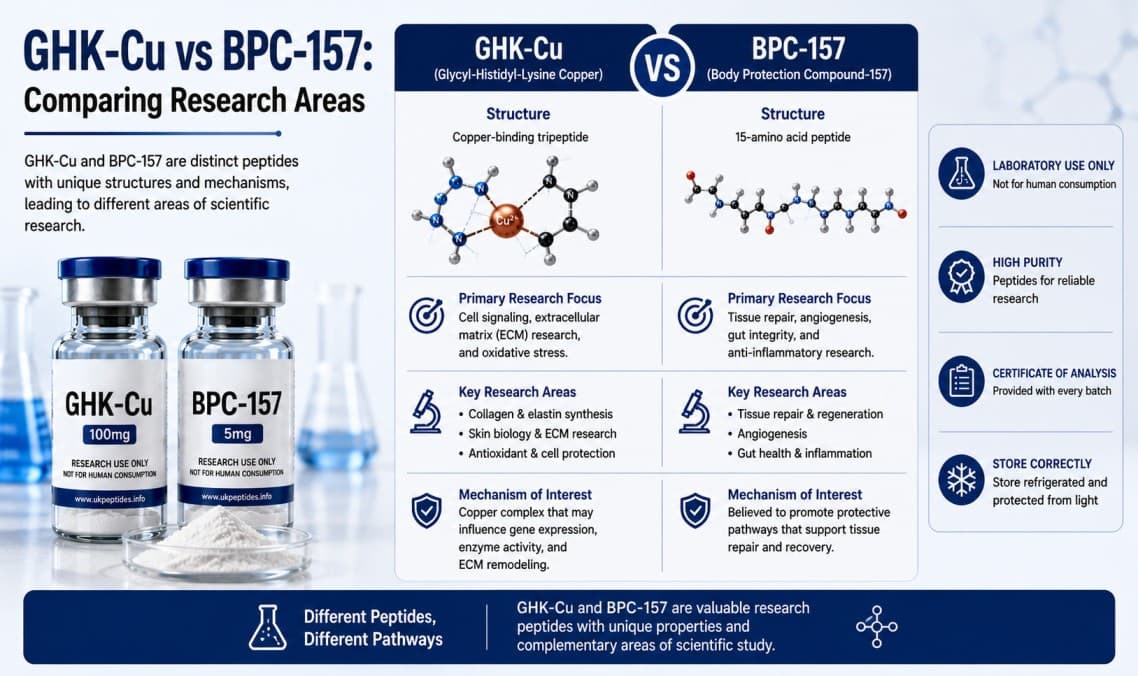
GHK-Cu and BPC-157 are two of the most frequently searched compounds in the peptide research space, and they're sometimes discussed as if they're interchangeable "repair peptides." In reality, they are chemically unrelated molecules studied in quite different research contexts, with some areas of overlap. This article compares what each is, what body of research exists for each, and where their research applications diverge.
GHK-Cu is a copper-binding tripeptide — three amino acids (glycine, histidine, lysine) complexed with a copper(II) ion — naturally occurring in human plasma and first isolated in the early 1970s. Its research relevance is tied closely to its copper-chelation chemistry, discussed in detail in our article on the science behind GHK-Cu's copper binding.
BPC-157 is structurally unrelated. It is a synthetic peptide fragment, 15 amino acids in length, derived from a naturally occurring protective protein found in human gastric juice (body protection compound). Unlike GHK-Cu, BPC-157 does not bind copper, and its proposed mechanisms in the literature centre on angiogenesis (new blood vessel formation) and modulation of growth factor pathways rather than copper-enzyme cofactor delivery.
Despite their structural differences, both peptides are frequently discussed in the research literature in connection with tissue repair and regeneration, which is likely why they are often mentioned together. GHK-Cu's research base in this area centres on extracellular matrix remodelling — collagen and elastin synthesis, matrix metalloproteinase regulation — primarily studied in dermal and connective tissue models. BPC-157's tissue-repair research, by contrast, spans a broader range of tissue types in preclinical models, including studies examining gut, tendon, ligament, and muscle tissue, with angiogenesis frequently cited as a proposed underlying mechanism.
GHK-Cu's most substantial research base is in dermal and connective tissue biology: fibroblast collagen synthesis, skin extracellular matrix remodelling, antioxidant enzyme support, and gene expression changes linked to cellular ageing. Its mechanism of action is comparatively well-characterised at the molecular level, owing to its well-understood copper-binding chemistry.
BPC-157's research base is broader in terms of tissue types studied — encompassing gastrointestinal, musculoskeletal, and neurological models in various animal studies — but its precise molecular mechanism is less definitively characterised than GHK-Cu's. Much of the interest in BPC-157 stems from its proposed pro-angiogenic and cytoprotective properties observed across these different preclinical models.
Both peptides share an important caveat that researchers should keep in mind: the overwhelming majority of published data for each compound comes from in vitro and animal studies, not controlled human clinical trials. GHK-Cu has a longer research history (dating to the 1970s) and a comparatively larger body of mechanistic in vitro work. BPC-157's literature, while growing, includes fewer well-controlled studies overall, and its precise receptor targets and mechanism remain less fully mapped than GHK-Cu's copper-chaperone model.
Because both peptides are implicated in tissue-repair signalling through different but potentially complementary mechanisms — GHK-Cuthrough copper-dependent extracellular matrix remodelling, BPC-157 through angiogenic and growth-factor pathways — some laboratories investigate them within the same combinatorial research protocols, alongside other peptides such as TB-500, to explore whether their proposed mechanisms produce additive or synergistic effects in specific experimental models. This is an active but still early area of comparative peptide research, and any combined findings should be treated as preliminary.
Both GHK-Cu and BPC-157 are, at the time of writing, unlicensed compounds in the UK — neither has MHRA marketing authorisation as a medicine. Both are legally supplied as laboratory research chemicals, provided they are marketed and sold strictly for research use, with no medicinal claims and no instructions for human or animal use. Neither is currently a controlled substance under the Misuse of Drugs Act, though researchers should always check current MHRA guidance, as the regulatory landscape for peptides continues to evolve.
The right compound depends entirely on the research question. If a study is investigating copper-dependent extracellular matrix biology, dermal fibroblast signalling, or antioxidant enzyme cofactor delivery, GHK-Cu is the more directly relevant and mechanistically characterised compound. If the research question concerns angiogenesis, broader tissue-repair signalling across musculoskeletal or gastrointestinal models, or growth-factor pathway modulation, BPC-157's literature is more directly applicable.
GHK-Cu and BPC-157 are structurally unrelated peptides that happen to share a general research theme — tissue repair and regeneration — while operating through different proposed mechanisms. GHK-Cu's research strength lies in copper-dependent extracellular matrix biology, while BPC-157's lies in its broader, though less mechanistically defined, angiogenic and cytoprotective research profile across multiple animal tissue models.
Research Use Disclaimer: This article is provided for informational and educational purposes only. GHK-Cu, BPC-157, and all products listed on ukpeptides.info are sold strictly for laboratory research use by qualified professionals and institutions. They are not licensed medicines, are not intended for human or animal consumption, and have not been evaluated by the MHRA for safety, dosing, or efficacy in people. Nothing in this article constitutes medical advice.
This article is provided for educational purposes to support laboratory research. All products supplied by UK Peptides are for in-vitro research use only and are not medicines, supplements, or intended for human or veterinary consumption.