Free UK tracked delivery on research orders over £75 — dispatched same day before 3pm
Free UK tracked delivery on research orders over £75 — dispatched same day before 3pm
GHK and GHK-Cu share the same peptide backbone, but GHK-Cu contains copper as part of its complex. This guide explains the key differences between the two compounds, including structure, copper binding, properties, and areas of scientific research.
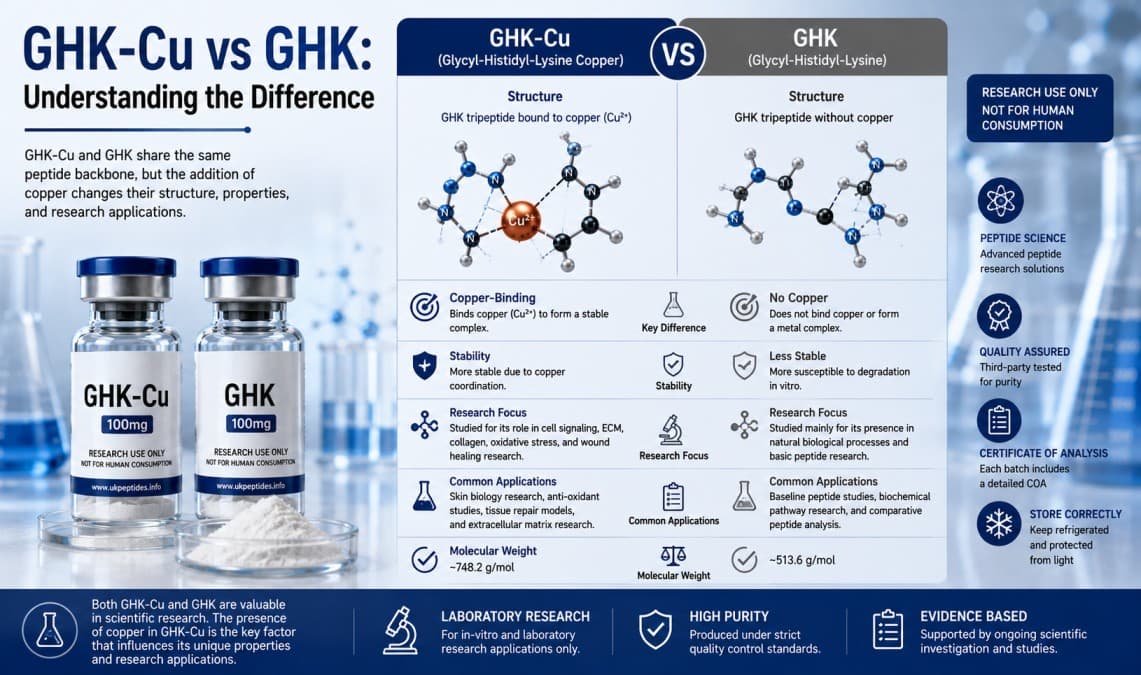
It's easy to assume that GHK and GHK-Cu are simply two names for the same compound. They share a peptide backbone, after all. But the presence or absence of a bound copper ion turns out to be a meaningfully important distinction in the research literature. This article breaks down what separates these two closely related molecules, and why the difference matters for laboratory work.
Both GHK and GHK-Cu are built on the same tripeptide sequence: glycine, histidine, and lysine. This sequence — first identified in human plasma by researcher Loren Pickart in the early 1970s — occurs naturally in the body. In its uncomplexed form, without a bound copper ion, it is simply referred to as GHK. When it is bound to a copper(II) ion, it becomes GHK-Cu, sometimes written as copper tripeptide-1.
At a structural level, the difference is a single copper ion. At a functional level, that single addition changes a great deal about how the molecule behaves and what it is studied for.
Much of GHK-Cu's proposed biological activity is thought to stem specifically from its copper-binding and copper-delivery properties — its role as a chaperone-like carrier that shuttles copper to enzymes that depend on it, such as lysyl oxidase and superoxide dismutase, without exposing tissue to the oxidative risks of free copper ions. This mechanism is covered in more depth in our article on the science of GHK-Cu's copper-binding chemistry.
The uncomplexed GHK peptide does not carry this copper-delivery function in the same way. While GHK itself has been studied to a lesser extent, and the peptide backbone alone may still interact with cellular receptors and signalling pathways independent of copper, a substantial portion of the research interest in this tripeptide sequence specifically concerns the copper-bound form. This is one reason GHK-Cu, rather than plain GHK, is the form most commonly referenced in the wound-healing, extracellular matrix, and gene-expression literature.
The copper ion also affects how the two forms behave in solution. GHK-Cu's copper coordination is pH-sensitive and can be disrupted by chelating agents, as covered in our storage and stability guide. Uncomplexed GHK does not have this same copper-coordination chemistry to manage, since there is no copper ion to lose. However, this also means uncomplexed GHK lacks the specific redox-buffering properties that researchers attribute to the copper-bound form. In practice, this makes GHK-Cu and GHK suited to different research questions: GHK-Cu for studies concerned with copper delivery and copper-dependent enzyme activity, and GHK where researchers specifically want to isolate the peptide backbone's activity independent of copper.
GHK-Cu dominates the published literature on:
Collagen and extracellular matrix remodelling in fibroblast models
Antioxidant and anti-inflammatory signalling linked to copper-dependent enzymes
Gene expression studies examining tissue regeneration and cellular ageing pathways
Wound-healing research in animal models
GHK (uncomplexed) appears more often in:
Comparative and mechanistic studies designed to separate peptide-specific effects from copper-specific effects
Some receptor-binding and signalling pathway research examining the peptide backbone in isolation
Because GHK-Cu represents the naturally occurring form found in human plasma — copper-bound, not free — it is also the more commercially available and more frequently referenced compound across peptide research catalogues.
Researchers new to this area sometimes encounter inconsistent naming in older literature or in commercial listings, where "GHK" is used loosely to refer to what is actually the copper-bound form. When evaluating a research supplier or a published study, it is worth checking explicitly whether the compound in question is described as copper-complexed (GHK-Cu, copper tripeptide-1) or as the uncomplexed peptide (GHK), since this distinction has real implications for expected activity in an experimental system.
For laboratories designing experiments, choosing between GHK and GHK-Cu is not a matter of picking whichever is more available — it should be driven by the specific research question. Studies interested in copper metabolism, copper-enzyme cofactor delivery, or the peptide's naturally occurring biological form should use GHK-Cu. Studies specifically aiming to isolate peptide-backbone effects from copper-related effects may deliberately compare both forms side by side, or use uncomplexed GHK as a control condition.
GHK and GHK-Cu share an identical amino acid backbone but differ in one critical respect: the presence of a bound copper ion. That difference is central to much of GHK-Cu's proposed mechanism of action, particularly its role in copper delivery to enzymes like lysyl oxidase and superoxide dismutase. Researchers should be precise about which form they are working with, both when designing experiments and when sourcing material from a research supplier.
**Research Use Disclaimer:** This article is provided for informational and educational purposes only. GHK-Cu and all products listed on ukpeptides.info are sold strictly for laboratory research use by qualified professionals and institutions. They are not licensed medicines, are not intended for human or animal consumption, and have not been evaluated by the MHRA for safety, dosing, or efficacy in people. Nothing in this article constitutes medical advice.
This article is provided for educational purposes to support laboratory research. All products supplied by UK Peptides are for in-vitro research use only and are not medicines, supplements, or intended for human or veterinary consumption.