Free UK tracked delivery on research orders over £75 — dispatched same day before 3pm
Free UK tracked delivery on research orders over £75 — dispatched same day before 3pm
GHK-Cu and TB-500 are distinct peptides studied across different areas of scientific research. This comparison explores their molecular characteristics, research focuses, mechanisms of interest, and potential applications in laboratory studies.
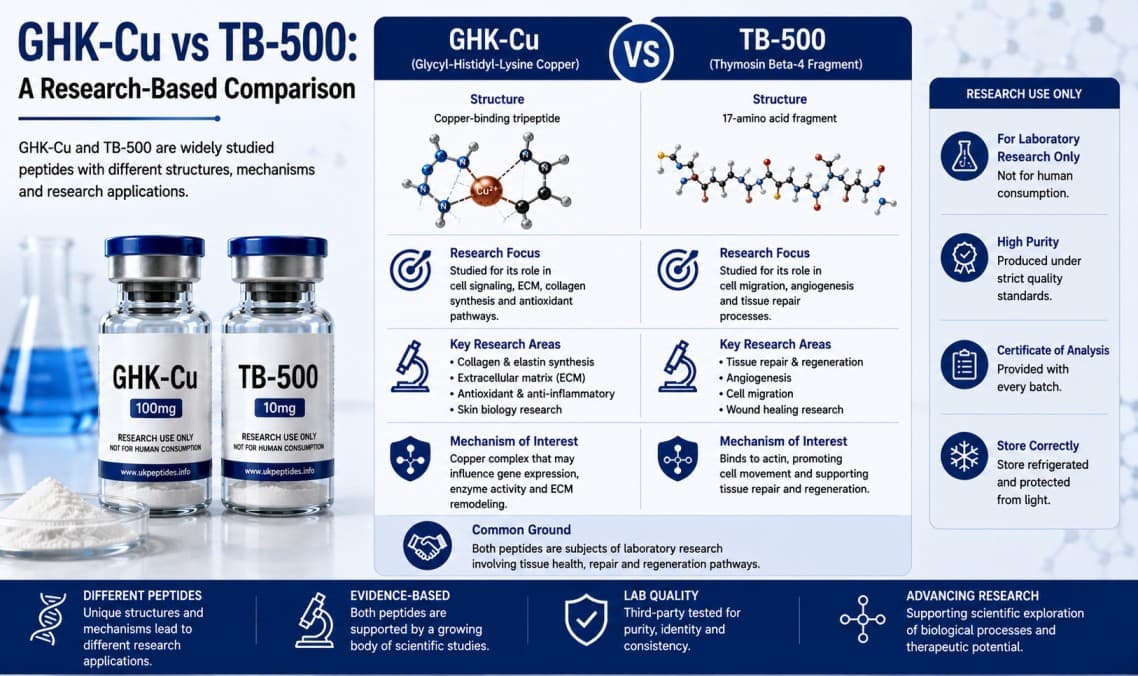
GHK-Cu and TB-500 both appear frequently in peptide research catalogues under the general banner of "tissue repair," but they come from entirely different biological families and are studied for different reasons. This article compares the two compounds on their chemistry, mechanism, and the current research literature supporting each.
GHK-Cu is a small tripeptide-copper complex — glycine, histidine, and lysine bound to a copper(II) ion — naturally occurring in human plasma and first characterised in the 1970s. Its research relevance is closely tied to its copper-binding chemistry and its proposed role in delivering copper to enzymes involved in collagen crosslinking and antioxidant defence.
TB-500 is something quite different: a synthetic peptide fragment derived from thymosin beta-4, a protein naturally involved in actin regulation — the cytoskeletal protein network that governs cell shape, movement, and migration. TB-500 does not bind copper and has no structural relationship to GHK-Cu. Its proposed research relevance centres on cell migration and the modulation of actin dynamics, which researchers have linked to processes involved in tissue repair, including in muscle, tendon, and vascular tissue in preclinical models.
GHK-Cu's proposed mechanism operates largely through copper delivery to specific enzymes — lysyl oxidase for collagen crosslinking, superoxide dismutase for antioxidant defence — and through downstream effects on gene expression related to extracellular matrix remodelling. This mechanism is relatively well-characterised at the molecular level, as detailed in our article on GHK-Cu's copper-binding science.
TB-500's proposed mechanism is different in kind: rather than acting as a metal chaperone, it is thought to influence actin polymerisation dynamics, potentially affecting cell migration and the movement of repair-related cells into damaged tissue in animal models. This actin-regulation hypothesis is the dominant explanatory framework in the existing TB-500 literature, though — as with many peptide research compounds — the full mechanistic picture is still being refined.
GHK-Cu is most heavily represented in the literature on:
Fibroblast collagen and elastin synthesis
Extracellular matrix remodelling in dermal tissue models
Antioxidant enzyme cofactor delivery
Gene expression changes associated with tissue regeneration and cellular ageing
TB-500 is more frequently studied in the context of:
Cell migration assays, particularly relating to actin cytoskeleton dynamics
Animal models of muscle, tendon, and cardiovascular tissue repair
Angiogenesis-adjacent research, examining how cell mobility contributes to new tissue formation
There is limited direct overlap in the specific molecular pathways each peptide is proposed to act through, even though both are broadly categorised under "tissue repair peptide" research.
Because GHK-Cu's proposed activity (extracellular matrix synthesis and remodelling) and TB-500's proposed activity (cell migration into damaged tissue) address different stages of a hypothetical tissue-repair process, some laboratories have explored combining them — along with other peptides such as BPC-157 — in multi-compound research protocols aimed at studying tissue regeneration from multiple angles simultaneously. This combinatorial approach remains an early-stage area of research, and findings from combined-compound studies should be interpreted cautiously, since interactions between compounds are harder to isolate than single-compound effects.
As with GHK-Cu, the TB-500 literature is dominated by in vitro and animal model studies rather than controlled human trials. TB-500 research, in particular, includes fewer long-running mechanistic studies than the GHK-Cu literature, which benefits from a research history stretching back over five decades. Researchers evaluating either compound should weigh the relative maturity of each evidence base accordingly, and treat proposed mechanisms as working hypotheses rather than settled science.
Neither GHK-Cu nor TB-500 holds MHRA marketing authorisation as a licensed medicine in the UK. Both may be lawfully supplied as laboratory research chemicals when marketed strictly for research use, without medicinal claims, dosing instructions, or any suggestion of suitability for human or animal administration. Researchers and suppliers should stay current with MHRA guidance, as the regulatory treatment of peptide research chemicals continues to develop.
If a research protocol is centred on extracellular matrix synthesis, collagen crosslinking, or copper-dependent enzyme activity, GHK-Cu is the more directly relevant compound, with a well-established mechanistic rationale. If the research question concerns cell migration, actin cytoskeleton dynamics, or broader tissue-repair processes in muscle, tendon, or vascular models, TB-500's literature is more applicable. The two are not substitutes for one another — they represent different biological toolkits.
GHK-Cu and TB-500 are unrelated peptides that are often grouped together under the general umbrella of "tissue repair research" despite having distinct chemical identities and proposed mechanisms. GHK-Cu's research strength lies in copper-dependent extracellular matrix biology; TB-500's lies in actin-related cell migration research. Understanding this distinction is important for designing well-targeted research protocols.
Research Use Disclaimer: This article is provided for informational and educational purposes only. GHK-Cu, TB-500, and all products listed on ukpeptides.info are sold strictly for laboratory research use by qualified professionals and institutions. They are not licensed medicines, are not intended for human or animal consumption, and have not been evaluated by the MHRA for safety, dosing, or efficacy in people. Nothing in this article constitutes medical advice.
This article is provided for educational purposes to support laboratory research. All products supplied by UK Peptides are for in-vitro research use only and are not medicines, supplements, or intended for human or veterinary consumption.