Free UK tracked delivery on research orders over £75 — dispatched same day before 3pm
Free UK tracked delivery on research orders over £75 — dispatched same day before 3pm
Discover how NAD+ and MOTS-C are studied in cellular and mitochondrial research. Explore their research roles, key pathways and quality considerations when buying these compounds in the UK.
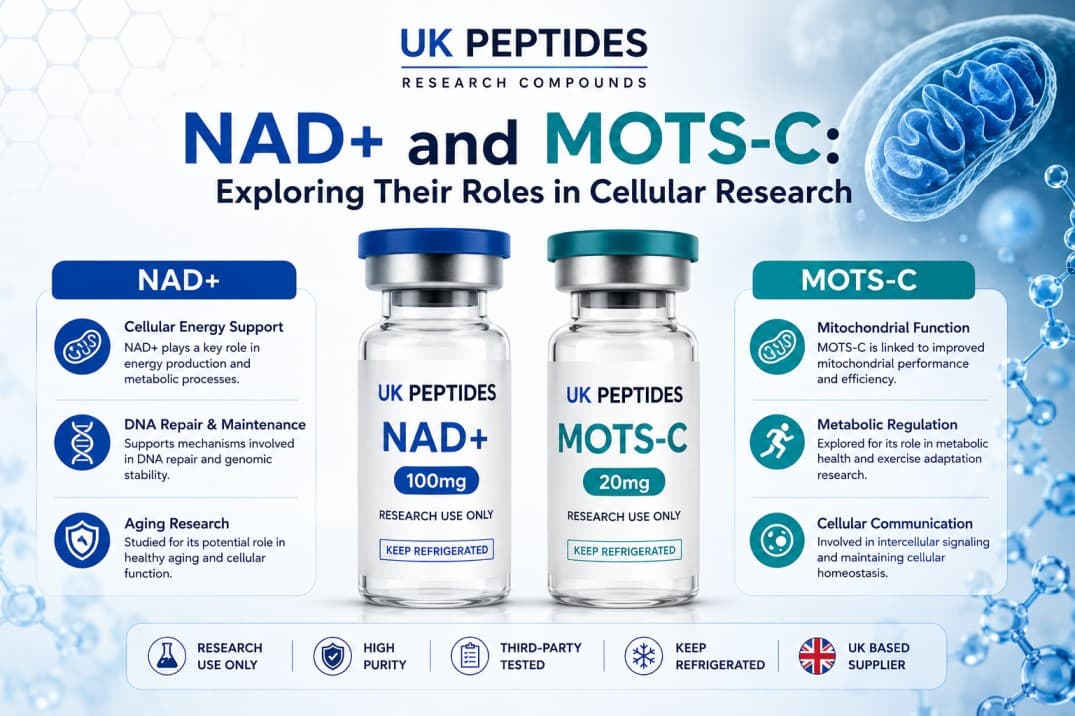
Though chemically unrelated, NAD+ and MOTS-C both sit at the centre of mitochondrial and cellular ageing research, making for a natural scientific comparison.
MOTS-C is a peptide encoded by mitochondrial DNA rather than the cell's nuclear genome — a mitochondrial-derived peptide, in scientific terms. It's a comparatively recent addition to peptide research and has attracted interest for its apparent involvement in metabolic regulation.
NAD+ and MOTS-C both feature in studies covering:
Mitochondrial efficiency and output
Cellular energy metabolism
Ageing-associated biological changes
Broader metabolic regulation
NAD+ functions as a coenzyme, central to redox chemistry and energy transfer across essentially every cell type. MOTS-C behaves more like a signalling molecule, thought to influence gene expression and metabolic activity from within the mitochondria itself.
Given their shared mitochondrial connection, some researchers explore how NAD+ availability might relate to MOTS-C activity, aiming to better understand mitochondrial coordination of energy and signalling.
UK Peptides supplies NAD+ and MOTS-C as separate, individually labelled research compounds, each with its own batch-specific documentation for laboratory use.
NAD+ and MOTS-C, as described here and supplied by UK Peptides, are research chemicals only — neither is licensed as a medicine by the MHRA, and neither is intended for human or animal use, consumption, or therapeutic application. This content is educational and not medical advice.
This article is provided for educational purposes to support laboratory research. All products supplied by UK Peptides are for in-vitro research use only and are not medicines, supplements, or intended for human or veterinary consumption.