Free UK tracked delivery on research orders over £75 — dispatched same day before 3pm
Free UK tracked delivery on research orders over £75 — dispatched same day before 3pm
NAD+ is one of the most talked-about molecules in ageing research. This guide explains what NAD+ is, why scientists are so interested in it, how it differs from NMN and NR, and what to check before you buy research-grade NAD+ in the UK.
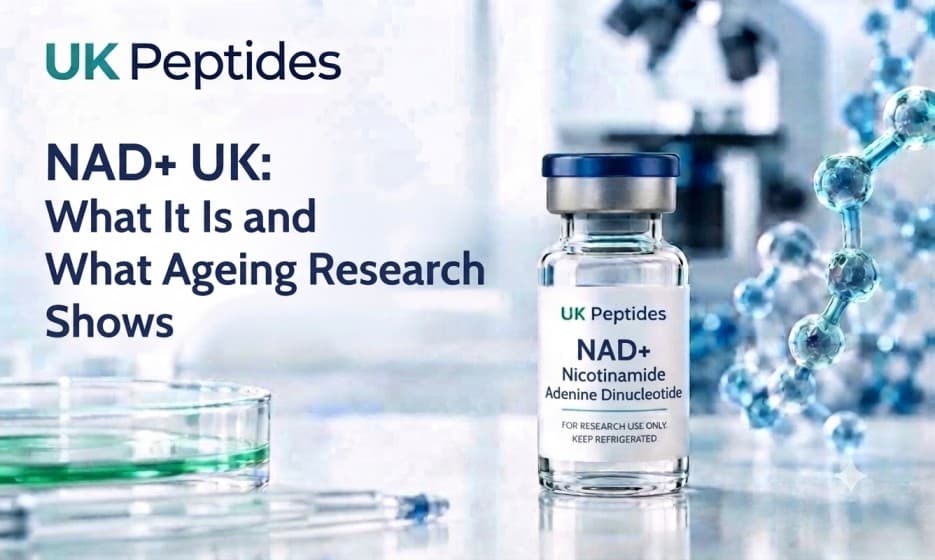
NAD+ stands for nicotinamide adenine dinucleotide. It is a helper molecule, called a coenzyme, found in every living cell. Without it, cells cannot turn food into energy.
NAD+ is not actually a peptide. It is sold alongside research peptides because it is supplied, stored and handled in the same way in the lab.
NAD+ has two main jobs:
Think of NAD+ as a shared supply that several important processes draw from. When the supply runs low, those processes may slow down.
Studies in many species show NAD+ levels drop in several tissues as we age. One leading explanation is an enzyme called CD38, which uses up more NAD+ as the body ages. This is why so much ageing research asks whether keeping NAD+ levels up could support the repair enzymes that depend on it.
This is one of the most common questions. NMN and NR are "precursors": the body converts them into NAD+. Most headlines and many human studies are about NMN or NR, not NAD+ itself. Research-grade NAD+ skips the conversion step, so results from NMN or NR studies cannot simply be applied to NAD+.
Yes. Research-grade NAD+ is legal to buy in the UK for laboratory research. It is not a licensed medicine and must be sold without dosing instructions or health claims. It is also regulated separately from NMN and NR food supplements.
NAD+ breaks down more easily than most peptides, so freshness matters. Look for:
UK Peptides (ukpeptides.info) supplies NAD+ with an independent Certificate of Analysis linked on the product page.
NAD+ is sensitive to light, moisture and repeated freezing and thawing. Store the powder frozen, and once mixed, split it into single-use portions rather than refreezing.
In the UK, research-grade NAD+ is sold for laboratory research. Scientists use it to study energy metabolism, DNA repair and ageing in cells and animals.
No. It is a coenzyme. It is grouped with peptides because it is supplied and stored the same way.
They are two forms of the same molecule. NAD+ is ready to accept electrons; NADH is carrying them.
No. Research-grade NAD+ is a laboratory material. Supplements are consumer products regulated under food law.
Related guides:MOTS-C UK Guide · Glutathione UK Guide
View NAD+ on UK Peptides → https://www.ukpeptides.info/product/nad-1000mg
For laboratory research use only. Not for human consumption.
This article is provided for educational purposes to support laboratory research. All products supplied by UK Peptides are for in-vitro research use only and are not medicines, supplements, or intended for human or veterinary consumption.