Free UK tracked delivery on research orders over £75 — dispatched same day before 3pm
Free UK tracked delivery on research orders over £75 — dispatched same day before 3pm
Explore the research differences between NAD+ and NMN, including how they relate to cellular metabolism and NAD+ pathways. Discover key quality factors to consider when buying NAD+ for research in the UK.
NAD+ vs NMN: Understanding the Research Differences
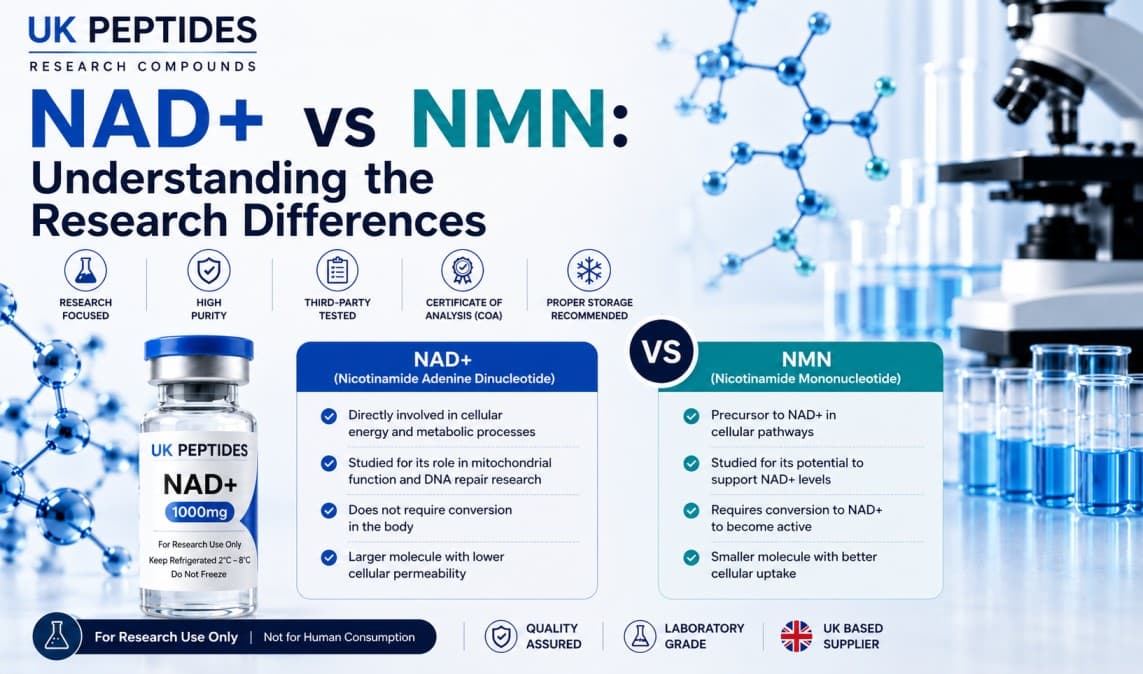
NAD+ and NMN (nicotinamide mononucleotide) turn up together constantly in ageing-related research, but they aren't interchangeable — each plays a distinct part in the same biological pathway.
NMN acts as a direct precursor to NAD+. Cells take up NMN and enzymatically convert it into NAD+, meaning NMN sits one metabolic step earlier in the process.
NAD+ is the active coenzyme itself, directly involved in electron transfer and redox reactions. NMN, by comparison, is a smaller, simpler molecule that must first be converted before it can perform NAD+'s functions.
Some labs work directly with NAD+ to examine its role in energy metabolism and DNA repair. Others focus on NMN specifically to understand how precursor availability influences the body's own NAD+ production. Studying both sheds light on the full pathway, not just one end of it.
Despite their differences, both molecules are used across studies on mitochondrial performance, sirtuin activity, and cellular ageing, with specific protocols varying depending on the research question at hand.
NAD+ and NMN, as supplied by UK Peptides, are for laboratory research only. Neither is licensed as a medicine by the MHRA, and neither is intended for human consumption. This piece is a research comparison, not supplementation guidance.
---
This article is provided for educational purposes to support laboratory research. All products supplied by UK Peptides are for in-vitro research use only and are not medicines, supplements, or intended for human or veterinary consumption.