Free UK tracked delivery on research orders over £75 — dispatched same day before 3pm
Free UK tracked delivery on research orders over £75 — dispatched same day before 3pm
Discover how GHK-Cu interacts with copper and why this copper-binding peptide is of interest in scientific research. This guide explores its molecular structure, copper coordination, key properties, and areas of laboratory research.
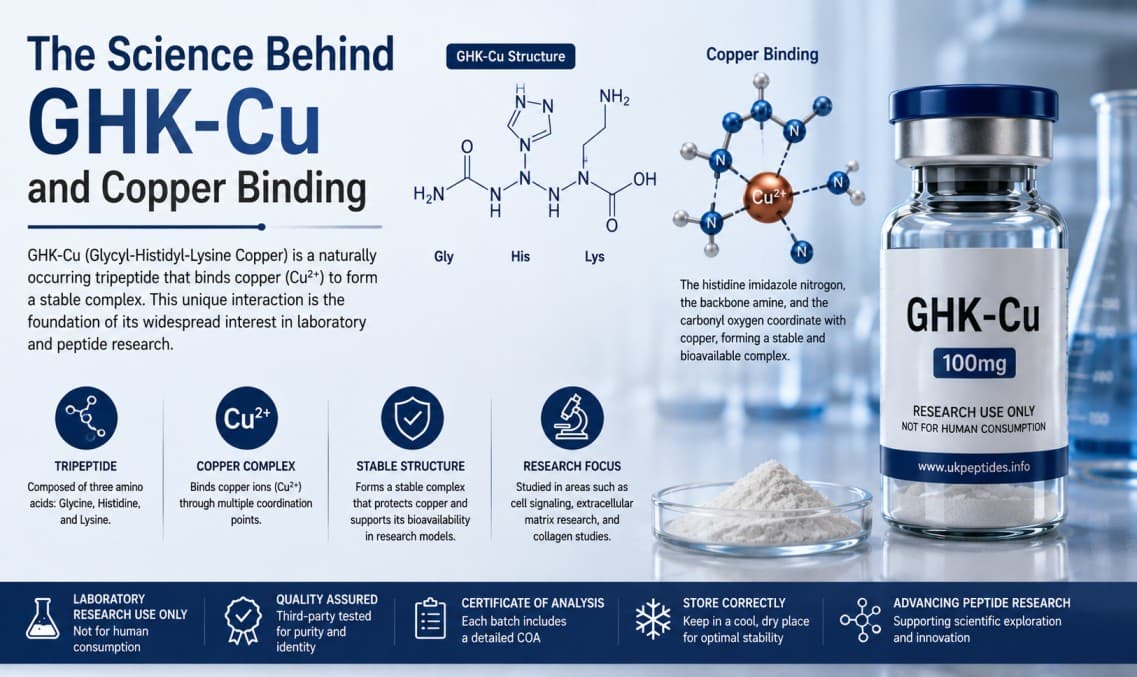
At the heart of every question researchers ask about GHK-Cu is a single piece of chemistry: how does a three-amino-acid peptide bind and manage a copper ion, and why does that matter biologically? This article looks more closely at the coordination chemistry of GHK-Cu, the biological logic of copper chaperoning, and how this shapes the peptide's role as a laboratory research tool.
Copper is an essential trace mineral required for a wide range of enzymatic processes, from cellular respiration to connective tissue formation. But copper's chemical usefulness — its ability to cycle between different oxidation states — is also what makes it hazardous in its free, unbound form. Free copper ions can participate in Fenton-like reactions that generate reactive oxygen species, causing oxidative damage to lipids, proteins, and DNA. Because of this, biological systems have evolved tightly regulated copper-handling machinery: transport proteins, storage proteins, and chaperones that shuttle copper directly to the enzymes that need it, without ever releasing it into the wider cellular environment as a free ion.
GHK-Cu's defining chemical feature is its very high binding affinity for copper(II) ions. The peptide's histidine residue, in particular, provides a favourable coordination site, allowing the tripeptide to form a stable complex with copper. Researchers have proposed that GHK-Cu functions in a way conceptually similar to established copper chaperone proteins — binding copper in a redox-silent form and delivering it to acceptor enzymes, rather than allowing it to circulate freely and generate oxidative damage.
This is sometimes described in the literature as a "chaperone-like" mechanism: GHK-Cu is not simply a copper carrier sitting inertly in solution, but a molecule whose biological activity appears to be closely tied to its capacity to donate copper to specific downstream targets under the right conditions.
Two enzyme systems come up repeatedly in GHK-Cu research as likely downstream beneficiaries of this copper-delivery activity:
Lysyl oxidase is a copper-dependent enzyme responsible for crosslinking collagen and elastin fibres in the extracellular matrix — a process essential to the mechanical strength and structure of connective tissue. Researchers have hypothesised that GHK-Cu's influence on collagen crosslinking in fibroblast culture models may be linked to its support of lysyl oxidase activity.
Superoxide dismutase (SOD) is a key antioxidant enzyme that neutralises superoxide radicals, and it also depends on copper (in one of its major isoforms) to function. Studies in macrophage cell models have reported that GHK-Cu treatment is associated with restored SOD activity alongside reduced reactive oxygen species levels, consistent with a copper-cofactor-supply mechanism.
Beyond these two, copper is a required cofactor for more than two dozen enzyme systems in mammalian biology, including cytochrome c oxidase, which is central to cellular energy production. This has led some researchers to propose that GHK-Cu's effects may extend into areas of cellular metabolism that are still being actively mapped.
The stability of the GHK-Cu complex is not absolute — it is sensitive to solution conditions, particularly pH. At lower pH (more acidic conditions), copper dissociation from the peptide scaffold increases, which can reduce the compound's biological activity in an experimental setting. This is a key practical consideration for laboratories working with GHK-Cuin solution, and it is one reason why storage and handling protocols (covered in a separate article on this site) specify particular pH ranges for reconstituted solutions.
Similarly, any chelating agents present in a buffer system — such as EDTA — can compete with the peptide for the copper ion, effectively stripping it from the complex and inactivating the compound for research purposes. Researchers designing experiments involving GHK-Cu need to account for this when selecting buffers and reagents.
Because GHK-Cu's biological activity is closely tied to its copper-binding chemistry, researchers have also used it as a reference point for studying related copper peptides. Comparative work with AHK-Cu — a structural analogue in which glycine is replaced with alanine — has been used to explore how small changes to the peptide backbone affect copper affinity, cellular signalling, and downstream biological outcomes. This comparative approach helps researchers separate which effects are attributable to copper delivery generally, and which depend on the specific peptide sequence.
For laboratories running experiments involving GHK-Cu, understanding its coordination chemistry is not an academic footnote — it directly affects experimental reproducibility. Variables such as solution pH, buffer composition, exposure to light (which can promote copper-mediated oxidative degradation), and peptide purity all have the potential to alter how much intact, biologically active GHK-Cu complex is actually present in an experimental system at the point of use.
GHK-Cu's research relevance is inseparable from its underlying chemistry: a small tripeptide capable of binding copper with high affinity, keeping it in a stable and non-toxic form, and — according to current hypotheses — delivering it to copper-dependent enzymes involved in collagen crosslinking, antioxidant defence, and beyond. This copper-chaperone model remains an active area of mechanistic investigation, and the practical stability of the complex under different solution conditions is a critical factor for any laboratory working with the compound.
Research Use Disclaimer: This article is provided for informational and educational purposes only. GHK-Cu and all products listed on ukpeptides.info are sold strictly for laboratory research use by qualified professionals and institutions. They are not licensed medicines, are not intended for human or animal consumption, and have not been evaluated by the MHRA for safety, dosing, or efficacy in people. Nothing in this article constitutes medical advice.
This article is provided for educational purposes to support laboratory research. All products supplied by UK Peptides are for in-vitro research use only and are not medicines, supplements, or intended for human or veterinary consumption.