Free UK tracked delivery on research orders over £75 — dispatched same day before 3pm
Free UK tracked delivery on research orders over £75 — dispatched same day before 3pm
KLOW has become a frequent reference point in peptide research literature. This article looks at how the blend is actually used in laboratory settings — the biological pathways it's studied against, the models researchers apply it to, and the practical handling considerations involved.
For laboratory and academic reference only. Research peptides are supplied for in vitro and preclinical laboratory use and are not approved for human or veterinary consumption.
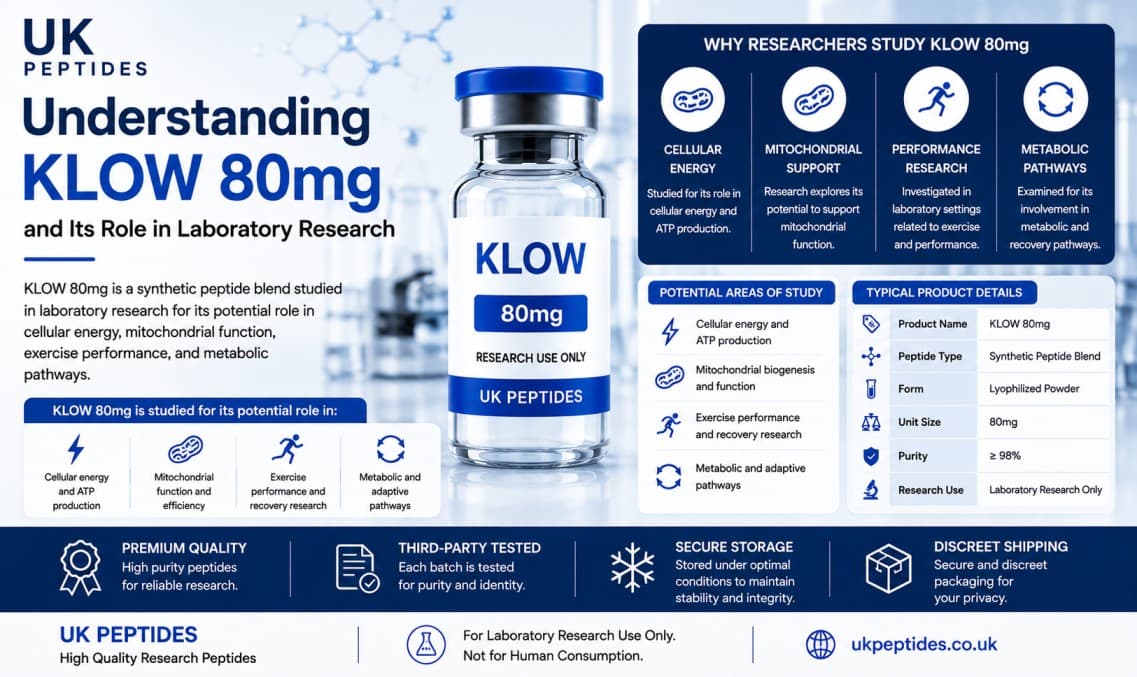
KLOW has become a recurring name in peptide research literature and supply catalogues alike. But what does it actually mean for a compound like this to have a "role" in laboratory research? This article looks past the basic composition and into how KLOW is actually positioned and used within a research context — the pathways it's studied against, the kinds of models it appears in, and the handling considerations that come with working with a multi-peptide blend.
KLOW combines four peptides — GHK-Cu, BPC-157, TB-500, and KPV — in a single lyophilized preparation, typically totalling 80mg per vial. Each component brings a separately documented biological pathway to the combination: GHK-Cu with copper-dependent gene expression and extracellular matrix regulation, BPC-157 with nitric oxide and VEGFR2-linked signalling, TB-500 with actin regulation and cell migration, and KPV with NF-κB-mediated inflammatory signalling.
Laboratory research increasingly looks at biological processes as systems rather than single pathways. Tissue repair is the clearest example: a wound-healing model involves inflammation, angiogenesis (new blood vessel formation), cell migration, and structural remodelling, often overlapping in time rather than occurring one after another.
This is the practical rationale for studying a blend like KLOW rather than its four components separately. A researcher modelling wound repair, for instance, might be interested in observing how a copper-dependent structural signal (GHK-Cu), a vascular signal (BPC-157), a migratory signal (TB-500), and an inflammatory-control signal (KPV) behave when present in the same experimental system, rather than inferring their combined effect from four disconnected single-peptide studies.
Based on the individual literature behind its four components, KLOW is most often discussed in connection with:
It's worth noting that most of this connection is inferential. The individual components have this research history; KLOW as a specific four-peptide combination has a comparatively thin, newer body of literature examining the blend directly, as opposed to its parts.
Working with a four-component blend introduces some handling considerations that don't apply to single peptides in the same way:
Reconstitution consistency. With four peptides of different molecular weights and solubility profiles freeze-dried together, consistent reconstitution technique matters more than it would for a single-peptide vial, to avoid uneven distribution of components in solution.
Stability and storage. As with most lyophilized peptides, KLOW is generally stored at low temperatures (typically –20°C or below) prior to reconstitution, and aliquoted after reconstitution to avoid repeated freeze-thaw cycles, which can degrade peptide structure over time.
Interpreting results. Because the blend introduces four potential mechanisms into a single experimental system, isolating which component (or combination of components) is responsible for an observed effect requires careful study design — often including control groups using the individual peptides alongside the full blend.
It's fair to describe KLOW's standing in the literature as still developing. The individual peptides that make it up — particularly BPC-157 and TB-500 — have a substantial body of preclinical, largely rodent-based research behind them. The blend itself, as a defined four-peptide combination, is a newer subject of study, and much of what's said about its combined effects remains extrapolated from the individual components rather than confirmed through dedicated blend-specific research.
KLOW's role in laboratory research is best understood as a tool for modelling multi-pathway biological processes — particularly tissue repair — in a single experimental system, rather than as a single, independently established compound. Its value to a given study depends heavily on study design, since attributing observed effects to specific components within the blend requires deliberate controls.
This article is for general educational and informational purposes only, aimed at a laboratory and research audience. It is not medical advice, not a recommendation for human or animal use, and not sourcing or purchasing guidance. KLOW and its components are not approved by the MHRA, FDA, or equivalent bodies for therapeutic use; consult a qualified professional and official regulators for further guidance.
This article is provided for educational purposes to support laboratory research. All products supplied by UK Peptides are for in-vitro research use only and are not medicines, supplements, or intended for human or veterinary consumption.