Free UK tracked delivery on research orders over £75 — dispatched same day before 3pm
Free UK tracked delivery on research orders over £75 — dispatched same day before 3pm
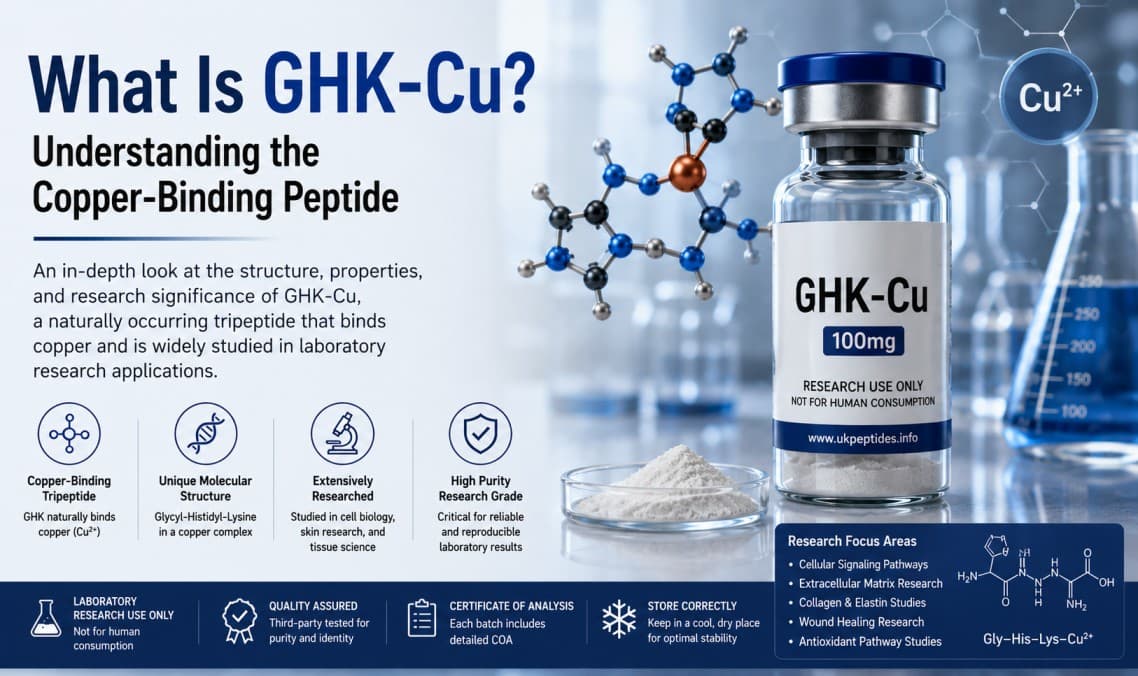
GHK-Cu is a naturally occurring copper-binding tripeptide that has attracted significant interest in scientific research. This guide explores the structure and properties of GHK-Cu, its interaction with copper, and key areas of laboratory research involving this peptide.
Among the growing catalogue of research peptides available to laboratories, GHK-Cu stands out both for its simplicity and its longevity in the scientific literature. It is a small molecule — just three amino acids and one copper ion — yet it has generated decades of published research spanning skin biology, wound healing, antioxidant defence, and gene expression. This article introduces GHK-Cu from first principles: what it is, where it comes from, and why researchers continue to study it.
GHK-Cu is short for glycyl-L-histidyl-L-lysine copper complex — a tripeptide made from three amino acids (glycine, histidine, and lysine) bound to a copper(II) ion. The "GHK" portion refers to the peptide backbone; the "Cu" denotes the coordinated copper ion. In the cosmetic ingredient world it is also known by its INCI name, copper tripeptide-1, reflecting its long history of use in topical formulations before its research applications expanded further.
Structurally, the histidine residue plays a central role, as its imidazole side chain is well suited to coordinating a copper ion. This copper-binding geometry is what gives GHK-Cu its defining biochemical property: the ability to hold onto a copper ion in a stable, non-reactive form while still allowing that copper to be released or transferred under the right biological conditions.
GHK-Cu is not an exotic laboratory invention — it occurs naturally in the human body, having been isolated from human plasma, and it is also detectable in saliva and urine. Researcher Loren Pickart identified it in the early 1970s while investigating why aged liver tissue samples behaved differently in culture depending on the plasma fraction they were exposed to. The peptide's structure was confirmed later in that decade, and interest in it grew steadily over the following decades as more of its biological activities were characterised.
Naturally occurring GHK-Cu levels in human plasma are known to decline with age, a pattern that helped drive early interest in the peptide as a subject of ageing-related research. The GHK-Cu used in laboratory and cosmetic settings today, however, is not extracted from human tissue — it is synthesised, allowing for standardised, reproducible material for research use.
Copper is an essential trace element involved in numerous enzymatic processes in the body, but free (unbound) copper ions are potentially toxic to cells because of their capacity to generate damaging reactive oxygen species. Biological systems generally handle copper transport through chaperone proteins that shuttle the ion safely to where it is needed.
GHK-Cu is thought to function in a broadly analogous way at a much smaller molecular scale: it binds copper tightly enough to keep it in a stable, "redox-silent" form, while still making that copper available to copper-dependent enzymes such as lysyl oxidase (involved in collagen crosslinking) and superoxide dismutase (an antioxidant enzyme). This copper-chaperone concept is central to much of the mechanistic research into how GHK-Cu produces its observed effects in cell culture models.
Since its identification, GHK-Cu has been examined across a wide range of laboratory contexts, including:
Extracellular matrix biology — its influence on collagen, elastin, and glycosaminoglycan synthesis in fibroblast cultures.
Wound healing models — its role in tissue repair signalling pathways in animal and cell-based studies.
Antioxidant and inflammatory signalling — its effects on reactive oxygen species and inflammatory markers in cultured immune cells.
Gene expression research — its use as a tool compound to study transcriptional responses linked to tissue remodelling and cellular ageing.
This breadth of research interest is part of why GHK-Cu appears so frequently across both academic literature and commercial research-peptide catalogues.
It is important for researchers and readers alike to understand where GHK-Cu sits in the evidence hierarchy. The majority of published findings come from in vitro (cell culture) and animal studies. Topical cosmetic use is the most clinically studied human application, largely in the context of skin appearance. Broader systemic claims about GHK-Cu remain preclinical and are the subject of ongoing investigation rather than established fact.
For laboratories working in dermal biology, wound-healing science, or copper metabolism, GHK-Cu offers a well-characterised, relatively simple molecule with a large existing body of comparative literature to build on. Its small size and known copper-binding chemistry also make it a useful model compound for studying structure-activity relationships against related copper peptides, such as AHK-Cu, which is covered in a separate article on this site.
GHK-Cu is a naturally occurring, copper-binding tripeptide first identified in human plasma in the 1970s. Its defining feature is its capacity to chelate copper in a stable, bioavailable form, a property believed to underlie its wide-ranging effects in laboratory models of tissue remodelling, oxidative stress, and gene expression. It remains one of the most studied small peptides in current research-chemical catalogues, with an evidence base that continues to grow.
Research Use Disclaimer: This article is provided for informational and educational purposes only. GHK-Cu and all products listed on ukpeptides.info are sold strictly for laboratory research use by qualified professionals and institutions. They are not licensed medicines, are not intended for human or animal consumption, and have not been evaluated by the MHRA for safety, dosing, or efficacy in people. Nothing in this article constitutes medical advice.
This article is provided for educational purposes to support laboratory research. All products supplied by UK Peptides are for in-vitro research use only and are not medicines, supplements, or intended for human or veterinary consumption.