Free UK tracked delivery on research orders over £75 — dispatched same day before 3pm
Free UK tracked delivery on research orders over £75 — dispatched same day before 3pm
New to KLOW? This in-depth beginner's guide breaks down what the blend actually contains, why researchers combine these four peptides, and the fundamentals you need before diving deeper into peptide science.
For laboratory and academic reference only. Research peptides are supplied for in vitro and preclinical laboratory use and are not approved for human or veterinary consumption.
If you're new to peptide science, "KLOW 80mg" is a name you'll run into fairly quickly. It sounds like a single compound, but it isn't — and understanding that distinction is the key to understanding everything else about it. This guide covers what KLOW actually is, what each part of it does, why it's studied as a group rather than four separate items, and how to think about it critically as a beginner.
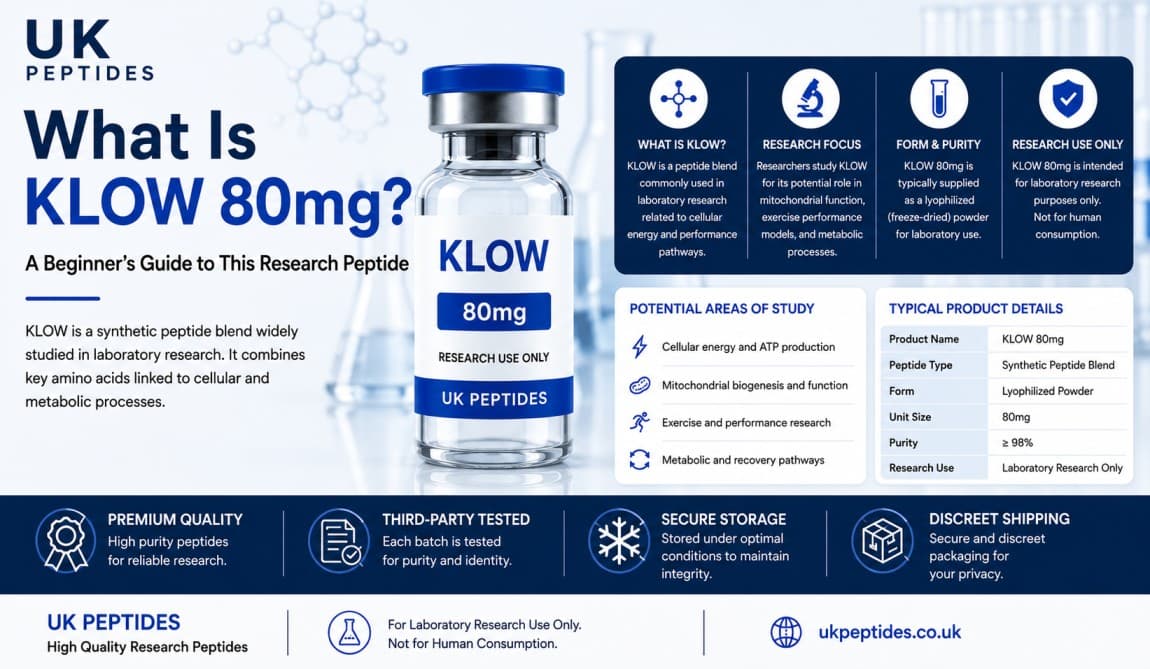
The four active components are GHK-Cu, BPC-157, TB-500, and KPV, most commonly supplied in an 80mg vial split roughly as 50mg GHK-Cu, 10mg BPC-157, 10mg TB-500, and 10mg KPV. The "KLOW" name is a product-naming convention used in the peptide research supply space — it doesn't map neatly letter-by-letter onto the four scientific names, so don't spend too much time trying to force the acronym to fit. It's simply become the common shorthand for this specific four-peptide combination.
| Component | Approx. share of an 80mg vial |
|---|---|
| [GHK-Cu | 50mg |
| BPC-157 | 10mg |
| [TB-500 | 10mg |
| KPV | 10mg |
It's worth getting to know each of the four building blocks individually, since almost everything written about KLOW's "mechanism" is really a discussion of these four peptides' individual, separately documented pathways.
GHK-Cu is a naturally occurring copper-binding tripeptide, present in human plasma, that declines with age. It has one of the longest research histories of the four components, with decades of literature on its role in copper-dependent gene expression, collagen synthesis, and extracellular matrix remodelling in skin and wound-healing models.
BPC-157 is a synthetic 15-amino-acid peptide derived from a protective protein found in gastric juice. It's one of the most frequently referenced peptides in rodent studies of tissue repair, largely because of its interactions with nitric oxide signalling and growth-factor receptor pathways like VEGFR2.
TB-500 is a shorter, synthetic version of a fragment of thymosin beta-4, a protein naturally involved in regulating the cell's internal skeleton (actin). It's studied for its role in cell migration and the formation of new blood vessels (angiogenesis) in experimental systems.
KPV is the smallest of the four — a tripeptide clipped from the tail end of a much larger hormone, α-MSH. Research on KPV has focused on its interaction with the NF-κB signalling pathway, which plays a central role in regulating inflammation at a cellular level.
Real biological processes are rarely driven by a single pathway. Tissue repair, for example, involves inflammation control, new blood vessel growth, cell migration, and structural rebuilding, often happening at overlapping stages rather than one at a time.
A single-peptide study can only speak to one piece of that puzzle. KLOW exists because researchers wanted a way to look at several of these pathways interacting within one experimental system, rather than running four separate studies and guessing at how the results might combine.
That said, it's worth staying grounded as a beginner: most of the reasoning behind combining these four specific peptides comes from what's known about each one on its own, not from a large independent body of research on the blend itself. The "synergy" framing you'll see in a lot of marketing copy is a hypothesis extrapolated from individual-peptide data, not necessarily an established, independently replicated finding.
You'll often see KLOW mentioned alongside a related, simpler blend called GLOW, which contains three of the same four peptides — GHK-Cu, BPC-157, and TB-500 — minus KPV. The practical difference is that KLOW adds an inflammation-focused signalling component (KPV) that GLOW doesn't include. If you're comparing the two, that's the core distinction to understand: three overlapping pathways versus four.
Like most research peptides, KLOW is typically supplied as a lyophilized (freeze-dried) powder rather than a pre-mixed liquid. This is standard practice because freeze-dried peptides are considerably more stable in storage than reconstituted solutions.
A few basics that apply broadly to lyophilized peptide blends like this one:
Disclaimer: KLOW 80mg is supplied strictly for laboratory research use only. It is not for human consumption, therapeutic, veterinary, cosmetic, or diagnostic use.
This article is provided for educational purposes to support laboratory research. All products supplied by UK Peptides are for in-vitro research use only and are not medicines, supplements, or intended for human or veterinary consumption.