Free UK tracked delivery on research orders over £75 — dispatched same day before 3pm
Free UK tracked delivery on research orders over £75 — dispatched same day before 3pm
Glutathione is often called the body's "master antioxidant", and it is one of the most studied molecules in cell research. This guide explains what glutathione is, how it protects cells, what the research shows, and what to check before you buy research-grade glutathione in the UK.
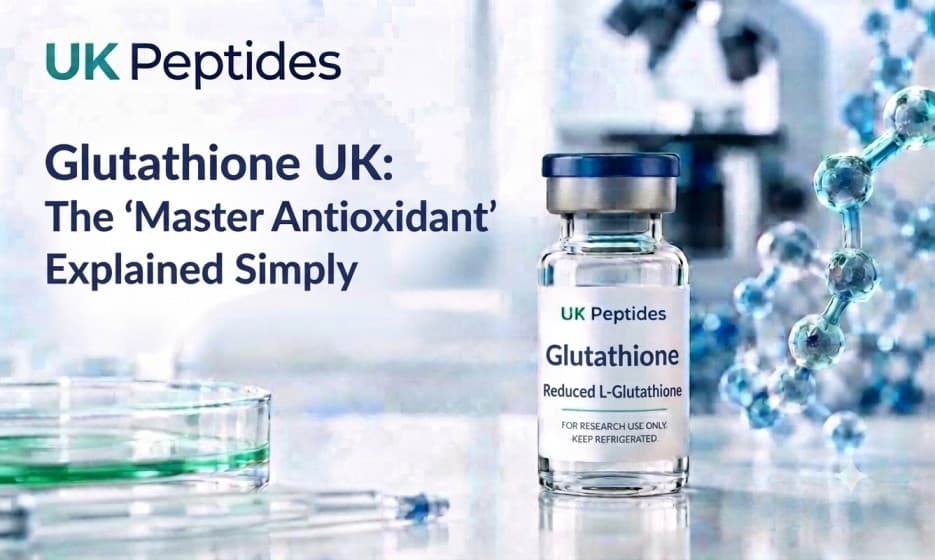
Glutathione is a small peptide made from three amino acids: glutamate, cysteine and glycine. Almost every cell in the body makes it, and it is the most common antioxidant inside cells.
It has an unusual structure. One of its bonds is joined in a different position from a normal peptide bond, which protects it from being broken down inside cells.
Cells constantly produce harmful by-products called free radicals (reactive oxygen species). If they build up, they can damage cells. This is called oxidative stress.
Glutathione protects cells in two main ways:
Glutathione comes in two forms. Reduced glutathione (GSH) is the active form that fights free radicals. After it does its job, two molecules join to become oxidised glutathione (GSSG). Cells then recycle GSSG back into GSH.
In healthy cells, there is far more GSH than GSSG. Scientists use the ratio between them as a standard measure of oxidative stress.
Yes. Research-grade glutathione is legal to buy in the UK for laboratory research. It is not a licensed medicine and must be sold without dosing instructions or health claims.
Glutathione slowly oxidises during storage, so a high purity figure alone is not enough. Look for:
UK Peptides (ukpeptides.info) supplies glutathione with an independent Certificate of Analysis linked on the product page.
Store the powder frozen, dry and away from light. Once mixed, glutathione oxidises over time, so prepare it fresh or freeze single-use portions.
NAC (N-acetylcysteine) is not glutathione. It supplies cysteine, the building block cells need most to make their own glutathione. That is why NAC is often used in research to raise glutathione levels indirectly.
In the UK, research-grade glutathione is sold for laboratory research. Scientists use it to study oxidative stress, detoxification and cell protection.
Because it is the most abundant antioxidant inside cells and supports other antioxidant systems. It is a popular nickname rather than a scientific term.
Yes. It is a tripeptide, meaning a chain of three amino acids.
It is the same molecule, but research-grade glutathione is a verified laboratory material, not a consumer product.
Related guides: NAD+ UK Guide · GHK-Cu UK Guide
View Glutathione on UK Peptides → https://www.ukpeptides.info/product/glutathione-1500mg
For laboratory research use only. Not for human consumption.
This article is provided for educational purposes to support laboratory research. All products supplied by UK Peptides are for in-vitro research use only and are not medicines, supplements, or intended for human or veterinary consumption.